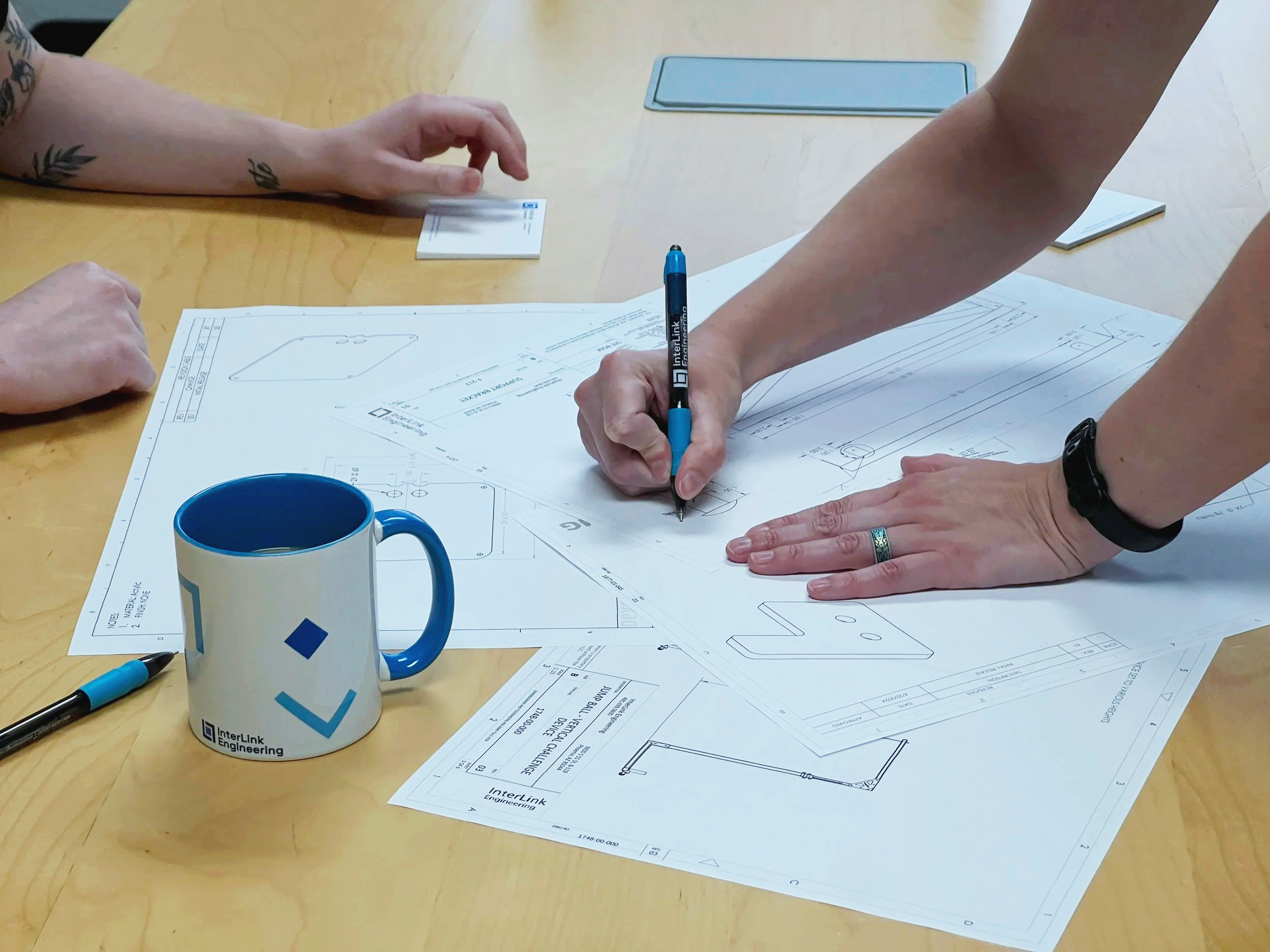
Why Manufacturing Drawings Make or Break Production
You’ve finalized the design. The CAD model looks great. The prototype has been approved. Now comes the part that determines whether production goes smoothly or turns into a series of costly questions and revisions.
Manufacturing drawings are often treated as the final step in the design process, but they’re one of the most important. They transform a design into a clear set of instructions that machinists, fabricators, inspectors, and assemblers can all follow. Without them, even a well-designed product can face delays, miscommunication, and unnecessary rework.
Whether you’re developing a new product, updating an existing one, or preparing for production, accurate manufacturing drawings help ensure everyone is working from the same information.
A CAD Model Isn’t Enough
Modern CAD software is incredibly powerful, but a 3D model alone rarely tells the full story.
A machinist needs to know which dimensions are critical. An inspector needs tolerances to verify the finished part. Purchasing may need a bill of materials, while assembly teams rely on detailed documentation to understand how components fit together.
Without that information, teams are left making assumptions. And assumptions on the shop floor can quickly become expensive.
Manufacturing drawings provide the details that turn a digital model into something that can be built consistently and correctly.
What Manufacturing Drawings Communicate
A manufacturing drawing does much more than show the shape of a part.
Depending on the project, it may include:
Critical dimensions
Geometric Dimensioning and Tolerancing (GD&T)
Material specifications
Surface finish requirements
Hole callouts and thread specifications
Weld symbols
Bill of Materials (BOM)
Assembly notes
Revision history
General manufacturing notes
Together, these details create a common language between engineering, manufacturing, quality, and purchasing.
When everyone is working from the same documentation, production becomes more predictable and efficient.
Common Problems That Slow Production
Even small omissions in a drawing can create significant issues once production begins.
Some of the most common challenges include:
Missing or Incomplete Dimensions
If a critical dimension is missing, manufacturing has to stop and ask questions before work can continue. That delay might only be a few hours, but across an entire project, those interruptions add up.
Tolerances That Don’t Match the Process
Applying unnecessarily tight tolerances can dramatically increase machining costs. On the other hand, tolerances that are too loose may affect product performance or assembly.
Good manufacturing drawings balance functionality with manufacturability.
Missing Manufacturing Notes
Information such as material requirements, coating specifications, inspection requirements, or assembly instructions often can’t be communicated by geometry alone.
Clear notes help eliminate uncertainty before production begins.
Manufacturing Drawings Are About More Than Documentation
Creating a manufacturing drawing isn’t simply a matter of placing dimensions on a model.
It requires understanding how the part will actually be made.
Questions like these influence how a drawing is created:
Can this feature realistically be machined?
Is there a simpler way to manufacture the part?
Are inspection requirements clearly defined?
Does the drawing communicate the design intent without overcomplicating production?
Are tolerances appropriate for the manufacturing process being used?
The best manufacturing drawings consider both engineering requirements and real-world manufacturing constraints.
Experienced engineers know a manufacturing drawing is more than documentation. It communicates design intent, manufacturing requirements, inspection criteria, and assembly details so every team is working from the same information.
Every Project Requires a Different Level of Support
No two manufacturers work exactly the same way, and neither do their engineering needs.
Some companies have an experienced engineering team but need additional drafting resources to meet deadlines. Others need support updating legacy documentation before launching new production. Some projects benefit from remote collaboration, while others move more efficiently with engineers working directly alongside the client’s team.
Our work with JumpBall is a great example of how effective remote collaboration can be. Over the past few years, we’ve partnered with the JumpBall team to help refine the product and develop the manufacturing documentation needed to support its evolution. Their passion for creating the best possible product and their active involvement throughout the process have made it a true collaboration, with ideas, feedback, and engineering expertise coming together every step of the way.
At the same time, we’re supporting other manufacturers through on-site engineering and drafting services, embedding our engineers with their teams to accelerate communication, resolve documentation challenges, and keep projects moving forward.
There’s no one-size-fits-all approach. The right solution depends on the project, the timeline, and the client’s internal resources.
Whether we’re collaborating remotely or working alongside a client’s team on-site, the goal remains the same: combining engineering expertise with clear manufacturing documentation to help turn great ideas into production-ready products.
Good Drawings Save More Than Time
It’s easy to think of manufacturing drawings as paperwork that simply needs to be completed before production begins.
In reality, they’re an investment.
Well-prepared drawings can help:
Reduce production delays
Minimize scrap and rework
Improve communication between departments
Simplify inspections
Support repeatable manufacturing
Reduce engineering questions during production
Speed up future design revisions
A clear drawing today often prevents multiple problems tomorrow.
Turning Designs Into Products
Every successful product reaches a point where ideas need to become clear instructions.
That’s the role manufacturing drawings play.
They connect design with production, reduce uncertainty, and help ensure the finished product reflects the engineer’s original intent.
Whether you’re developing a new product, updating existing documentation, or preparing a design for manufacturing, investing in accurate manufacturing drawings can make the difference between a smooth production launch and an expensive round of revisions.
At InterLink Engineering, we help manufacturers create clear, production-ready documentation through both remote drafting services and on-site engineering support. Whether you need additional drafting capacity, help updating legacy drawings, or engineering resources embedded with your team, we’re here to help move your project from design to production with confidence.