A Nerdy Guide to 3D Scanning and Reverse Engineering
The Case of the Broken Part
Picture this. A big machine at a factory stops. Clunk. A small metal part inside has cracked.
No problem, right? Just order a new one.
But wait. The company that made it closed years ago. There is no drawing. There is no file. There is just one broken part, sitting in someone's hand.
Now what?
This is where engineers get to be detectives. The job is called reverse engineering. And for some parts, we bring a very cool gadget along: a 3D scanner.
Grab your magnifying glass. Let's crack the case.
Reverse Engineering: Building Backwards
Most of the time, engineers start with an idea. They draw it. Then they make it.
Reverse engineering flips that around. We start with the real part. Then we work backward to make the drawing.
Think of it like a cookie. You eat an amazing cookie at a friend's house. There's no recipe. So you look at it. You taste it. You guess what went in. Then you write your own recipe. Now you can bake that cookie again and again.
That's what we do with parts. Only our cookies are made of steel. (Please don't eat them.)
Our "recipe" is a 3D model on the computer. It's called a CAD model. CAD stands for computer-aided design. Once we have it, we can do a lot. We can make a copy. We can fix a weak spot. We can even make the part better than it was before.
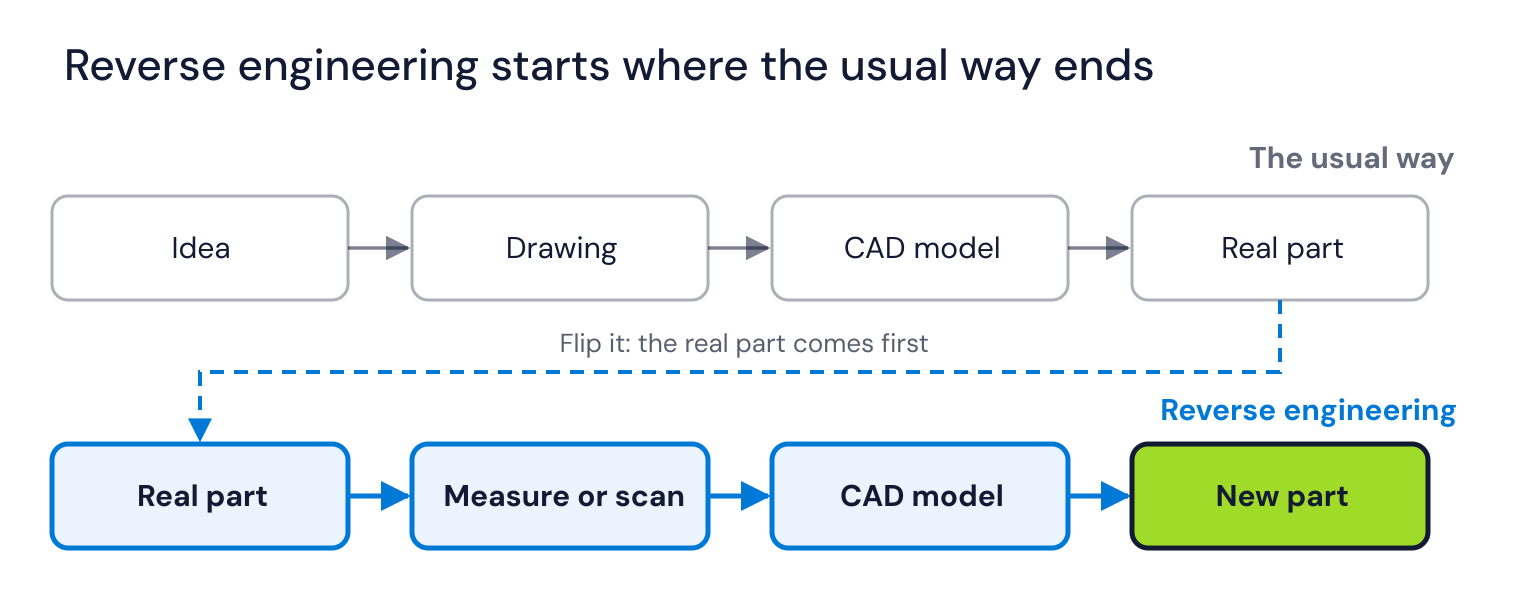
Same trip. Just started from the other end.
How a 3D Scanner Sees
First, a secret. Lots of parts don't need a scanner at all. Flat sides? Round holes? Straight edges? A sharp engineer with calipers can measure those by hand. Fast and exact.
But some parts are sneaky. They have swoopy curves. Bumps. Twists. Shapes like a handle that fits your hand just right. Measuring those with a ruler is really hard.
That's when the scanner shines. Literally.
Here's how most scanners work:
Shine. The scanner shines light on the part. Some use a laser line. Some flash a pattern of stripes.
Watch. A camera watches the light. It sees how the light bends over every bump and curve.
Do the math. The light comes from one spot. The camera sits in another spot. The computer knows how far apart they are. So it can use a triangle to find exactly where the light landed. This is called triangulation. Your two eyes do something like this to judge distance. Neat, huh?
Save a dot. Each spot gets saved as one tiny dot in 3D space.
Now do that again. And again. And again. Millions of times.
You end up with a cloud of dots shaped just like the part. Engineers call it a point cloud. Yes, really. It looks like a ghost of the part made out of sand.
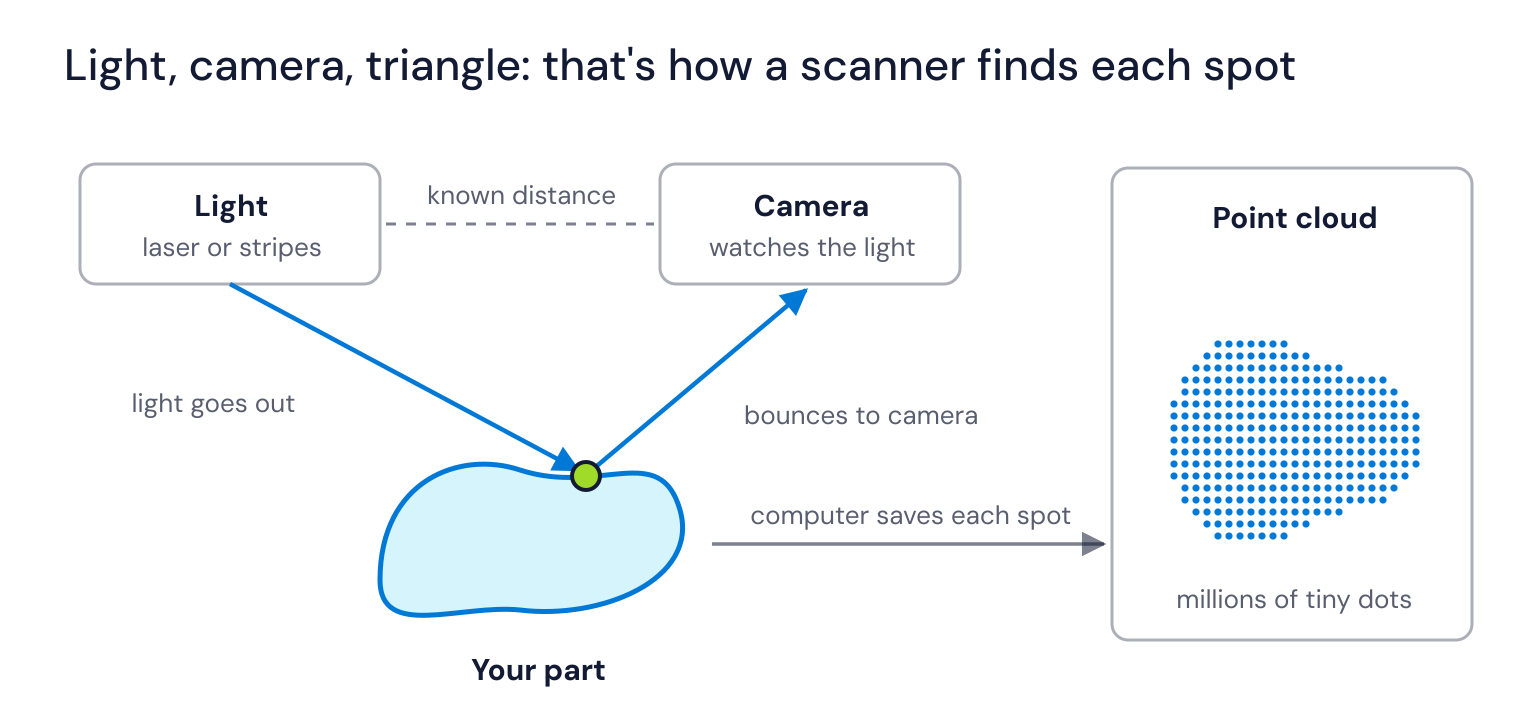
One spot at a time. Really, really fast.
From Broken Part to Brand-New Part
So how does a cracked part become a shiny new one? It takes a little trip.
Study the part. What does it do? What does it touch? What is it made of? Detectives look for clues first.
Measure it. Simple shapes get measured by hand. Curvy shapes get scanned. Some parts get both.
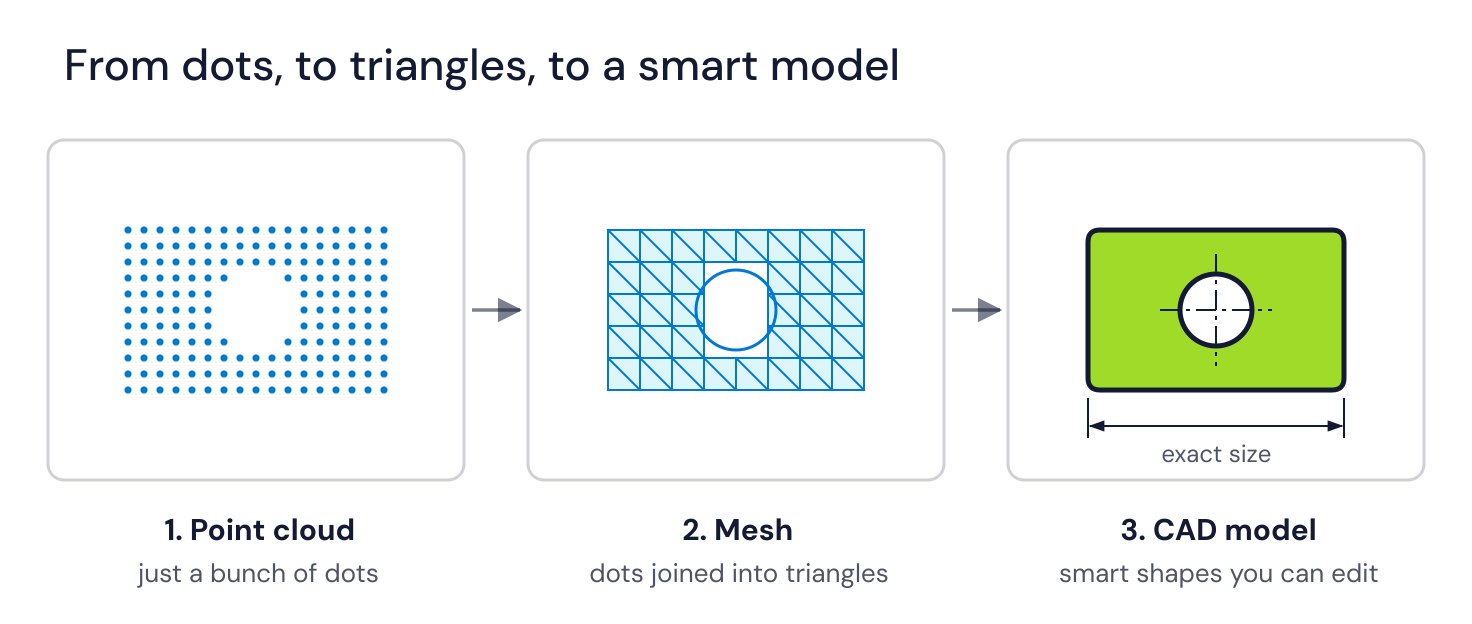
Connect the dots. A point cloud is just dots. So the computer joins them into tiny triangles. This is called a mesh. Think of a disco ball, but way more detailed.
Build the CAD model. A mesh is not a recipe yet. So an engineer rebuilds the part with clean, smart shapes. Here's a pro move: an old part is often worn down. It isn't the size it was made to be. So we figure out the size it should be.
Check it. We test the model. Does it fit? Does it line up with the parts around it?
Make it. Now the fun part. The part gets machined, built, and tested. Hello, new part!
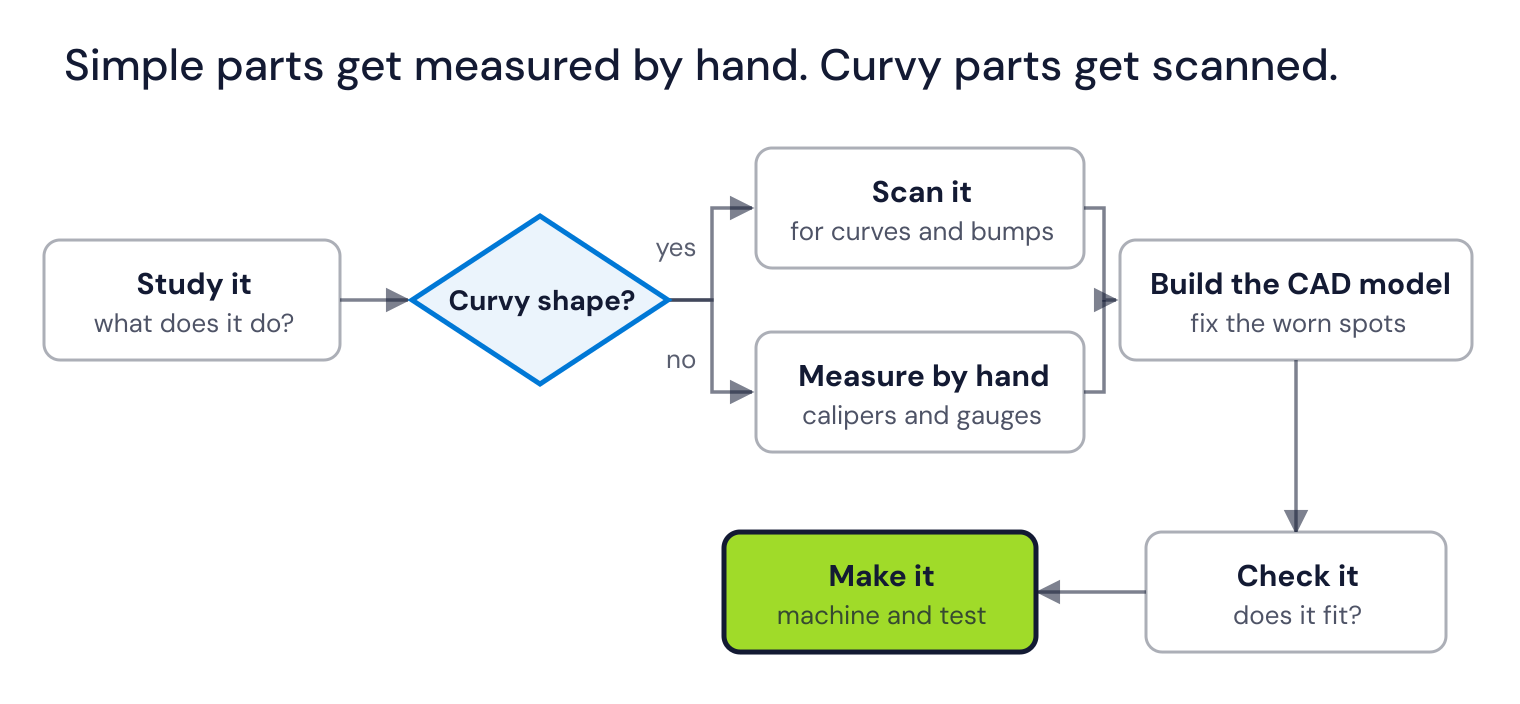
Not every part needs a scanner. The shape decides. And here's what a scan turns into along the way:
Where This Saves the Day
Reverse engineering pops up in more places than you might think. It helps in factories, hospitals, cars, planes, and more. Here are a few times it comes to the rescue:
The old machine. It still runs great. But nobody has the drawings anymore.
The part nobody makes. The maker stopped selling it. Or went out of business.
The part that keeps breaking. Why copy a weak part? Let's make it stronger.
The perfect fit. You need a new part that hugs an old, curvy one. A scan makes that easy.
The double check. A part was just made. Does it match the design? A scan can tell.
Nerd Corner
Ready for some bonus facts? Push up your glasses.
Shiny parts are tricky. Light bounces off them like a mirror. So the scanner can't see well. The fix? A thin spray that makes the part dull for a little while.
Stickers help. Tiny dot stickers on or around a part help some scanners know where they are. They're like trail markers on a hike.
A scan is not a recipe. A scan is like a photo of a shape. A CAD model is the recipe. You need the recipe to change things or make more.
Triangles everywhere. A mesh can have thousands or even millions of tiny triangles. Video game characters are built from triangles too!
Case Closed (and That's a Wrap on 2026!)
So there you have it. A broken part with no drawing is not the end of the story. It's the start of a fun puzzle. Study it. Measure it or scan it. Build the recipe. Make it again. Maybe even make it better.
This is our last blog post of the year. Thanks for reading along with us! We hope you learned something. We hope you smiled, too.
Got a mystery part of your own? Bring it to us. We love a good puzzle.
Want to just chat about it first? Stop by our free design office hours. They happen every third Thursday of the month, 3 to 4 PM, at the InterLink office. No signup needed. Just show up.
Happy holidays from all of us at InterLink Engineering. See you in the new year!